Lizardfolk
“All life begins and ends with the tribe. Loyalty to your family is everything.” – Shaman Salazar Trueblood
Description
While no one statement easily describes the enigmatic Lizardfolk tribes, they come in essentially, one of three flavours; isolationist, reluctant participant, or outgoing adventurer. The Lizardfolk live within wet and swampy lands all over the world and are often ignored or left alone by most other cultures because of their reclusive nature and inhabitation of undesired land. This ‘let live and leave me alone’ attitude has led most Lizardfolk tribes to be more level-headed than other races, and this has afforded them unusual freedoms to spread across the continent relatively unhindered by borders or traditional land claims.
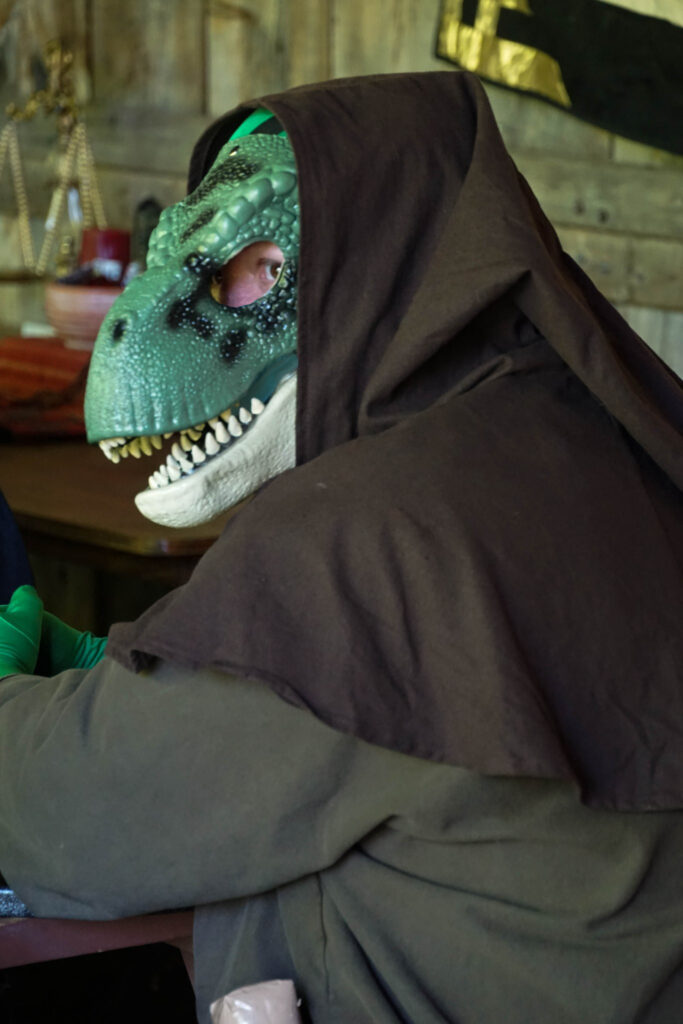
Lizardfolk populations are hard for outsiders to estimate; some clans migrate constantly across their territories, while others do set up more permanent settlements in order to conduct trade or business with other nearby populations. Lizardfolk are famously closed-lipped about their numbers to outsiders, although it is assumed that individual settlements have their own head-count. The migrants are typically those who refuse to interact with members outside their species, whereas those that choose to live in their village swamps, are resigned to dealing with others. Many are good-natured about it, although mixed interactions with representatives of other species has led to some cultural distrust in deals and bargains struck with outsiders. Those few that leave their nomadic groups or settlements are ready for a time of excitement and danger, but many find their way back to either a migratory or village living situation, depending on where they are in their lifecycle.
While not physically strong, they are unnaturally tough and resilient, able to drop their tails to escape a sticky situation. The limb regrows usually within a month as their healing and regenerative properties are powerful. Lizardfolk are notorious for being unable to resist mind spells and other mind-altering effects. Lizardfolk focus on oral traditions and divine magic more than many of the other sapient species of Ariel.
The racial characteristics of Lizardfolk are scales covering the entire body and face which can be any colouration found on real lizards and a lizard-like tail.
Racial Bonuses
- Begin with 10 Skill Points (SP)
- Begin with 6 Life Points (LP)
- Begin with 2 Resurrections
- Begin with Escape skill for free
- May purchase LP to a maximum of 15 LP
- May purchase the Physical Endurance skill for half cost (rounded up)
- May purchase the Resist Movement skill for half cost (rounded up)
- May purchase Rapid Healing skill without Prerequisites for half cost (rounded up)
- Unable to purchase Iron Will skill
- Must pay +2 SP to purchase Exceptional Strength
- Must pay double for Read & Write skill
- Must pay double for Read Magic skill
Mandatory Costuming
- Scaled Skin (makeup or prosthetics should cover exposed skin)
- Colouration representative of any real world lizards
- Solid, singularly black or brown make-up is not permitted
- Lizard-like tail
Racial Aging
| Youth | Elderly | Aging | Max. Age |
|---|---|---|---|
| 16 years | 40 years | 2 years | 70 years |
Youth: This is the minimum starting age for a given race. This is also the minimum age that can be achieved through rejuvenating spells.
Elderly: This is the age when the effects of time begin to take their toll and benchmarks aging negatives for a character, eventually affecting their Life Points.
Aging: Upon reaching the age indicated in the “Elderly” column, a character’s maximum LP decreases 1 Life Point for every increment of years indicated in the “Aging” column. For example, if the racial maximum LP for a goblin is 8 LP, a 42-year-old goblin character would have a maximum Life Points of 6. (A 42-year-old Goblin is 12 years over “Elderly” and, marking two increments of aging at 5 years each, reducing that characters’ Life Points by 2.)
Maximum Age: Upon reaching the age indicated in “Max. Age” the character is deceased and may not resurrect.
Nations and Lands
The Lizardfolk of Ariel are hearty and adaptable, with most of their permanent settlements in lands that are too hostile or too remote to be conquered. Freed from the need to defend themselves, the Lizardfolk who choose such settlements pursue their philosophy, art, or style of combat without significant concern of the depredations of hostile nations or even most monsters. From the perspective of others, the Lizardfolk are simple, inhabiting scrubland that nobody would reasonably desire.
Those that eschew permanent settlements have gathering points in the lands through which they cross, where they can usually be found at different parts of the year. These nomadic Lizardfolk are often more marked by time and their travels, but tend to be more sociable and have more trappings of wealth about them, often serving as travelling merchants or traders in the lands through which they venture.
- Blackmire – The dark waters of Blackmire give the lands their name; a large swamp through which a millennia-old mangrove knots and twists, making travel for the uninitiated treacherous and confusing. The Lizardfolk who make the Blackmire their home know of several large caverns in the Mire, where supplies can be stored, and which remain warm and well-ventilated enough for most of the Folk to winter within. Blackmire Lizardfolk have a large population of Jerroh and Atha priests among them, and some of those faiths make pilgrimages to visit and train with the Folk – if they prove worthy.
- Thornmallow Isle – A large island into the West Sea off the western shores of Ariel, Thornmallow Isle is temperate the year round, and is a largely agrarian society tended to by the Lizardfolk that live there. The Folk of Thornmallow are thoughtful and reflective, in no hurry to be anywhere or go anywhere with any real haste, with their dominant faith being that of Elieff. The herbalists of Thornmallow Isle sell small shipments to mainland settlements – when they need things that they cannot produce themselves.
- The Moors of Oolm – A massive peat bog, the Moors of Oolm were, in ancient times, the site of a great battle. The dead lie, naturally mummified by the chill and caustic waters, beneath the massive peat which the Lizardfolk cut for fuel and trade. The Lizardfolk dwellings are houses on stilts, for while brief exposure to the water is not terrible, metal swiftly corrodes from the Breath of Oolm. It is rumoured that among the Folk that live in the Moors, there are some necromancers who control the dead, keeping them dormant – unless needed. The Folk of the Moors will occasionally venture forth, often bearing with them relics recovered during their fishing or other business in the waters beneath, returning them to the nearest representatives of the species of they that had it in life.
- Firewatch Bay – Sitting in the caldera of Mutterpeak, the Lizardfolk settlement of Firewatch Bay are friendly to strangers, with a strong presence of Callis priests of all species present, in patient watch over the place where the Mountain Fire incident once drove off orc and goblin armies, when the gnomes deliberately ignited the volcano. The area is rich both in farming and minerals, and the Lizardfolk that hail from Firewatch Bay say that living in the shadow of such destructive history makes their lives filled with meaning: the reminder that life can be brief and swiftly overturned is everpresent, and makes them appreciate the now.
- Askala – Hidden within the Middle Deeps, this enclave is surrounded by thick sulphurous vents whose output feed the rich and often toxic gardens of mushrooms and strange mosses that feed the Askala fortress. The Lizardfolk from here are pale and have strange eyes, and it is rumoured that they guard the fortress against those that would plunder a relic hidden within. The Lizardfolk will not say, and perhaps most do not even know – but they will trade the poisons that they ferment to the nearby D’Shunn cavern of Serozarran.
- The Trackless Salts – Not a singular settlement, but a number of semi-nomadic groups that circulate through the Great Southern Desert separating most of Ariel from the Southern Kingdoms. The Lizardfolk of the Trackless Salts will often trade in semi-precious stones for wood and cloth, but no outsiders are welcome within their camps or those few areas where they have set up a semi-permanent residences, laying claim to some of the few oases needed to survive within this inhospitable environment.
Of course, there are as many or more Lizardfolk who do not settle down – these roving groups follow instinct and ancient traditions, crossing Ariel and pursuing any of the common callings that so mark the lives of the rest of Ariel’s residents.
History
If the Lizardfolk are even willing to speak with outsiders about the origins of their species, it becomes immediately clear that details conflict. Many Lizardfolk claim that they have a strong connection with the elemental gods, Atha, Callis, Beldon, Alwyn, and Balaxa, and it is from this that they derive their strong connections to nature and natural resilience. Still, whether this is just a manifestation of pronounced faith or an actual origin story is hotly debated, even among the Lizardfolk themselves.
What can be confirmed is that Lizardfolk were among the first sapient species, with the oldest Lizardfolk settlement ruins dating back to thousands of years before the tear. Although some Lizardfolk claim that their ancestors were dragons, it seems that there is little evidence supporting this, and Lizardfolk scholars, shamans, and sages view such a viewpoint as self-aggrandizing nonsense. During the time of the Golden Empire, Lizardfolk settlements existed both within and outside of the Empire’s control, and a famous tablet surviving from the age of the Empire suggests that imperial bureaucrats weren’t quite sure what to make of the Folk.
The Lizardfolk, although having little use for written languages, do have a common writing that mostly takes the form of complex hieroglyphics, used by alchemists, wizards, and other scholars who need little shared writings with representatives of other species. In place of this, the Lizardfolk oral tradition tells of the period between the Tear and the second age of reason, describing the affairs of other sapients from an outsider’s perspective.
The Lizardfolk themselves apparently settled several large cities during the Age of Blood, only to see them fall under siege to minotaur and orc forces. The Moors of Oolm are a settlement upon a battlefield just outside of the City of Oolm, which now lies wholly abandoned, and thought to deeply haunted, by the offensives and counteroffensives that brought low the city’s walls. As their strongholds fell, those who fled the cities took up with the more nomadic and dispersed settlements of their kinfolk, and it is in such locations that Lizardfolk herbalists developed some of the strong blended mixtures that now define contemporary herbalism.
Lizardfolk did not enter the Continental Trade Agreement until considerably after the first such agreement was signed, in 1852 A.T., and most of the Lizardfolk nations did not enter even then. Only Blackmire, Oolm, and Firewatch Bay entered into the trade agreement, along with two of the larger nomadic caravans. Mostly the reclusive Lizardfolk kept their own counsel, intervening in worldly affairs only intermittently, and when inscrutable signals from the Heavens or the Web of Fate so bade them.
Culture
As many Lizardfolk find phonetic writings to be unintuitive, and their own written language complex by its very nature, Lizardfolk have a strong oral tradition of history and storytelling. Lizardfolk storytellers are famed for their long and expansive memories; years of training go into the perfect recitations of history, from which no deviation is permitted. Those who tell stories for entertainment are allowed colour and elabouration, even on traditional stories; the Lizardfolk recognize the value of a tale well told in enjoyment or moral education, but insist upon word-perfection for the recounting of history.
Lizardfolk musicians favour complex rhythms beat out on complex sets of toned drums. Many also favour woodwind or stringed instruments, and their songs often interweave with their storytelling, offering verse and meter to measure out the feet of a complex tale. Shizzlas Songweaver, a famous Lizardfolk minstrel, is said to have composed a beautiful opera that tells the tale of the Tear, passed down through generations of Lizardfolk, with an aria that is said to have been able to make a statue weep – only for the unusual circumstances of their death leading to their family burying the work, fearing it to be cursed.
Lizard visual art will often tell a story, with many visual artists among the Folk being at least somewhat familiar with the complex pictographic language of their people. Indeed, in some ways, Lizardfolk tapestry and murals could be described as a form of poetry; rich in meaning, the images worked into the art tell a through-line narrative that sums up the emotional or cultural significance of the piece.
Faith
Although many Lizardfolk struggle with the written languages required to work as wizards and alchemists, there is a strong undercurrent of deep and abiding spiritualism in most places where Lizardfolk gather. Some groups cleave quite tightly to the elemental gods, but there are few restrictions on what faiths the Folk may gravitate toward – except for cultural taboos, usually local, but some widespread such as distaste for the worship of Stasa, goddess of unnatural death and undeath.
Among those found in the more permanent settlements are Lizardfolk quite adept at pickling and fermenting, and consequently, within them has been something of a renaissance of the worship of Blythe, deity of disease, rot, and poison. Although those who inflict disease within their settlements are still outcast, the teachings of Blythe are applied to the brewing of alcohol and preservation through fermentation and salting. This is not often spoken of with outsiders, who naturally fear the hand of Blythe in any settlement.
The Antisidereals
It is not uncommon for some Lizardfolk to seek a life outside of the nomadic bands or nations of the Folk. Many will find their way back, but there are legends of the antisidereals, those whose deeds are not foretold in the weave of Fate or the movement of the stars. Such Folk often grow powerful indeed, and rarely spend any great amount of time living comfortably; chasing adventure, and forging their own path, as none has been laid for them. Powerful seers have said that such Lizardfolk have no defined fate, and that it simply sloughs from them like shed skin.
Authored by: Andrew Dunlop
Fantasy Alive Lore Team 2026
Copyright © Endless Adventures Ontario