Gnomes
“Hey! If I put some of those yellow leaves in this potion it starts making a loud whistling sound … Oooh, look at the light!” – Last words of Tborren F’Norn, Gnomish Alchemist
Description
It’s often said that it’s easier to stop the passage of time than the racing mind of a gnome. Though something of a hyperbole, gnomish intellect is renowned in the worlds of alchemy and herbalism alike for their natural affinity for the complex sciences. Their metabolism allows them to process toxins far better than other races. However, this comes at cost to their muscle density. Though they are not limited in physical stature, they are simply incapable of ever achieving exceptional levels of strength.
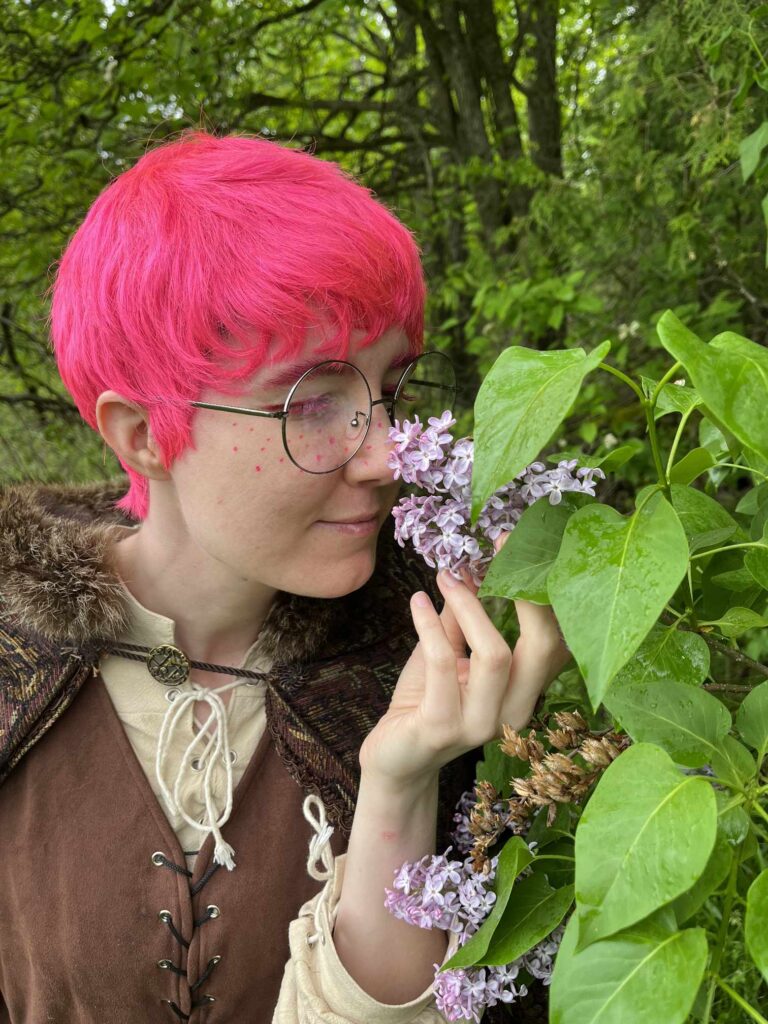
Gnomes are easily recognizable by their heads of intensely vibrant hair in shades of green, pink, yellow, orange, or blue. A gnome’s eyebrows and any facial hair also grow in the same bright colours. Some gnomes have been known to freckles that match their hair as well.
Some believe that a gnome’s hair colour tells something of their personality. Blue hairs are thought to be more reasonable, at least by gnomish standards. Greens are talented herbalists and alchemists, or poisoners depending who you ask. Orange hairs are inquisitive and tend towards invention, and away from safety guidelines. Pinks are the free spirits, or the sweetly naive of the race. And yellow haired gnomes are thought to be gifted as seers, though usually destined for madness. This ‘gnomenclature,’ as it is sometimes called, is typically rebuked by gnomes as nothing beyond a stereotype when confronted with it personally. However, it is hardly uncommon for them to buy into it themselves to some degree or another.
Racial Bonuses
- Begin with 10 Skill Points (SP)
- Begin with 4 Life Points (LP)
- Begin with 2 Resurrections
- Begin with one Resist Poison skill
- May purchase additional Resist Poison skills without the prerequisite 8LP
- May purchase LP to a maximum of 8 LP
- May purchase Herbalism skill for 2 SP less per level
- May purchase Alchemy skill for 2 SP less per level
- Cannot purchase the Physical Prowess skill
Mandatory Costuming
- Brightly coloured hair: Green, Pink, Yellow, Orange, or Blue. This must be a worn wig completely covering all of the players natural hair and any hair on the face must be coloured to match. (A player with their natural hair dyed is not acceptable)
- Optionally, costuming may include freckles of the same colour as the hair.
Racial Aging
| Youth | Elderly | Aging | Max. Age |
|---|---|---|---|
| 20 years | 50 years | 5 years | 90 years |
Youth: This is the minimum starting age for a given race. This is also the minimum age that can be achieved through rejuvenating spells.
Elderly: This is the age when the effects of time begin to take their toll and benchmarks aging negatives for a character, eventually affecting their Life Points.
Aging: Upon reaching the age indicated in the “Elderly” column, a character’s maximum LP decreases 1 Life Point for every increment of years indicated in the “Aging” column. For example, if the racial maximum LP for a goblin is 8 LP, a 42-year-old goblin character would have a maximum Life Points of 6. (A 42-year-old Goblin is 12 years over “Elderly” and, marking two increments of aging at 5 years each, reducing that characters’ Life Points by 2.)
Maximum Age: Upon reaching the age indicated in “Max. Age” the character is deceased and may not resurrect.
Nations and Lands
- Splishenfellow is one of the two nearest gnomish lands to Harodom, and with Detter, together make up the large gnome settlements of the Lakes Region. Although Detter and Splishenfellow are geographically distant, political marriages and alliances mean that the two nations share a monarchy and (technically) an aristocracy. Splishenfellow’s domestic national politics involve a House of Lords and House of Commons, two theoretically equal branches, with one house representing the landed interests of the generational aristocrats, and the other house representing popularly nominated representatives of the people.
Although not as imposing as the military of nearby Michian, Splishenfellow has the Splishenfellowegian Expeditionary Guard, a group of highly trained soldiers and specialists that act as explorers, irregulars, and guerrillas in the event of war. - Detter is across a portion of the Ire from Harodom, and shares a monarchy with Splishenfellow, although the two nations are technically independent from one another. Detter is more pastoral; bordered by Lake Ire, their coast is substantially protected from invasion by the dwellers within the lake, with (some of) whom they have a mutual nonaggression pact. Detter has a large merchant marine, and reportedly an even larger contingent of smugglers, moving prescribed alchemies and herbal mixtures into areas where their import or sale is restricted.
- Muttercap is a coastal nation of gnomes, above the winter snowline on the coast of the Ocean of Peace. Near neighbours to the rich mines of the Wheel and Trollblighter Dwarven clans, Muttercap’s alchemists have helped to make the nation rich, selling alchemical mixtures that help to mine and process some of the rare metals that the dwarves extract, as well as to help deal with the threats local to the area.
Muttercap’s penchant for alchemical experimentation has made them famous (or, perhaps, infamous) for the Muttercap Demolitions Teams, sappers and berserk warriors who charge into battle strapped with gas traps, trusting in their own resistance to poison and agility to carry them clear of the danger. While largely untested against regular forces in the last few centuries, raiding bands of irregulars have gone up against the self-named teams, and word has definitely spread. - Whistlewind is an agricultural powerhouse, both because of the fertile plains in which it is situated, and the extensive studies that its residents have conducted in fertilizers and pest control. Although a primarily gnomish nation, Whistlewind has benefited from a comfortable trading partnership with the nearby goblin nation of Strewth, and some amount of free movement of the citizens between the two have meant that about twenty percent of the population of Whistlewind are goblins, who share the gnomes’ curiosity.
Whistlewind is defended by a larger standing force than many; as an agricultural powerhouse, it can afford more full-time soldiers, who are themselves supplemented by the famed Beetle Riders, an armoured cavalry. This has come in handy, as there are a number of unquiet dead in the area around Whistlewind – old battlefields and the Necropolis of An’xar, belching forth undead forces every rainy season, as more tombs come uncovered.
History
Due to a long association between the two peoples, most non-gnomish history books tell the histories of gnomes in the same breath as the history of dwarves. While it may be true that the two species have an interwoven history, gnomes have a proud and independent history that stands on its own strength.
The two oldest remaining gnomish nations seem to be built around Muttercap and Splishenfellow. Muttercap’s response to the displacement of goblin and orc legions following the Second War of Understone was to ignite a nearby dormant volcano using tactical engineering and potent alchemical mixtures. In addition to nearly wiping out both armies, the Mountain Fire Incident also destroyed most of the then city of Muttercap, which had been evacuated against that possibility. Settling outside of the immediate blast radius, the nation of Muttercap was arguably founded in 151 A.T. Although some records survived the destruction of the original city of Muttercap, notably absent was the means by which the volcano was awakened (possibly in an effort to prevent curious gnomes from trying to replicate the experiment).
Splishenfellow is thought to have been founded in about 295 A.T., as local settlements of gnomes drew together to define the boundaries of a nation. The royal family of Splishenfellow are thought to be indirect descendants of the original family which spearheaded this conglomeration. Official histories that survive from this time speak of some kind of martial dispute with neighbouring dwarven clans; the same period in the dwarven lands discuss a wash of narcotics coming over the border from Splishenfellow.
Whistlewind has a more defined history; the nation dates back to 1263, when survivors of the fallen city of Windhallow created a new homeland some distance away. Windhallow’s fate is not specified in Whistlewind’s national archives, but there are allusions to a ‘Great Storm’, and the summoning of the Elemental Prince of Air, Caesairperrayin, The Endless Hurricane. Whistlewind has structures that are thought to have originally been devotional buildings to Alwyn; although this is not now the state faith of Whistlewind, families dedicated to the worship of Alwyn do make up a disproportionate percentage of the faithful in the nation.
Last of the existing gnomish nations to be founded was Detter; history books state that Detter was founded as a nation in 1523 A.T., following the War of the Twins. The War overtook the gnomish nation of Fingersplint, with the gnomes of Fingersplint having joined the Alliance forces in opposing the twins. Following the war, surviving refugees from the fallen nation re-settled on the banks of the Ire, naming their new nation after the largest city in Fingersplint. Detter’s governance was shaky at first, even with an alliance with Splishenfellow, and the royal families married in order to secure that alliance more firmly. After several generations, the royal families merged, although the nations did not.
Gnomish Culture
To try to encompass even all of modern gnomish culture in a finite document would be impossible. In many senses, gnomish culture is ever-changing – while traditions exist (and stereotypes exist with cause), there is no ‘wrong way’ to be a gnome, somehow even more so than there is no ‘wrong way’ to be any other sapient person of Ariel. In the interests of brevity, this document covers a few major touchstones, and broad tendencies, without asserting any kind of uniform ‘correctness’.
In study, gnomes have a tendency toward incremental growth of knowledge, pushed forward by what might be described as as large bump of curiosity. Although natural gifts in the crafting of alchemical and herbal solutions incline many gnomes to at least dabble in these arts, the same studious nature that creates gifted alchemists and herbalists produces excellent physicians and wizards. Careful study by gnomish scholars has made great leaps in both the arts of anatomy and spellcraft, with ‘outside-the-box’ thinking making intuitive leaps that more traditional scholars of magery might not have made based on the same premises. The gnomish inclination toward divination tends to manifest as a hunger for knowledge and the ability to see the unseen.
In art, gnomes tend toward playfulness in form and colour, sometimes pushing the boundaries of representational painting and sculpture in an effort to better represent what the subject of the art is to the artist – the philosophy that anyone with an apple can tell you what an apple looks like, but that the goal of an artist is to show you what an apple means. Gnomish music tends to be spirited and up-beat, with teasing themes and interlocking counterpoint; there are some gnomish compositions that have the listener convinced that three different songs have been played, until the themes collide, interlocking like the gears in the finest acme of the mechanic’s art. Gnomish theater covers all subjects, but the plays that do best internationally tend to be uproarious farces and comedies, even if not all of the nuances of gnomish humour necessarily travel.
In politics, gnomes are often very hands-on. Local plebiscites and community meetings enjoy considerable community engagement, with old decisions and grudges scrupulously poured over as new decisions are considered. Not for nothing is it said ‘if you want five considered opinions on a matter, ask three gnomes’.
In faith, gnomes may be well found in most any body of faithful, although none of the major nations of gnomes formally permit the worship of Kazzok, Stasa, Blythe, or Astrid. Taking matters of faith very seriously, gnomish bodies of faithful trend toward schism, as the meticulous unpacking of religious dogma and doctrine inform new approaches to existing practices that bear little doctrinal similarity to how the people originally developing that doctrine might have viewed it.
In war, gnomish military leaders will often treat the entire practice of military conflict as a lateral thinking exercise, making their next steps and moves difficult for enemies to predict. Although not individually resilient to harm, gnomish soldiers excel in cavalry actions, and make for some of the finest duelists known in the Lakes Region, with many martially-inclined gnomes sporting the odd duelist’s scar acquired at some point in the course of their education. Perhaps more worrying still, gnomes will often deploy considerable volumes of alchemical and herbal mixtures on the battlefield, trusting in their own ability to evade or endure the fruits of their labour asymmetrically to their opponents.
The Porphyrae
Said to have been a faction of the gnomes during the Golden Age of Magic, legends tell that the Porphyrae were banished away for crimes – although the nature of those crimes varies from telling to telling. No sign of these ‘Star Gnomes’ appears on Ariel to this day, but their name still makes its way into gnomish ghost stories of haunts and boogeymen. If there is any truth to the legends of the Porphyr, it’s probably for the best that they remain vanished from the face of the world, for their treating with Outsiders is said to have given them ungnomish strength and resilience, in addition to an utter lack of experimental scruples.
Authored by: Andrew Dunlop
Fantasy Alive Lore Team 2026
Copyright © Endless Adventures Ontario