Goblins
“Stop looking at me like that, this’ll work! …and if it doesn’t, the resulting confusion will be a great distraction and then we just stab ‘em in the back. Either way, job done, right?” – Gibrock the Singed, goblin General
Description
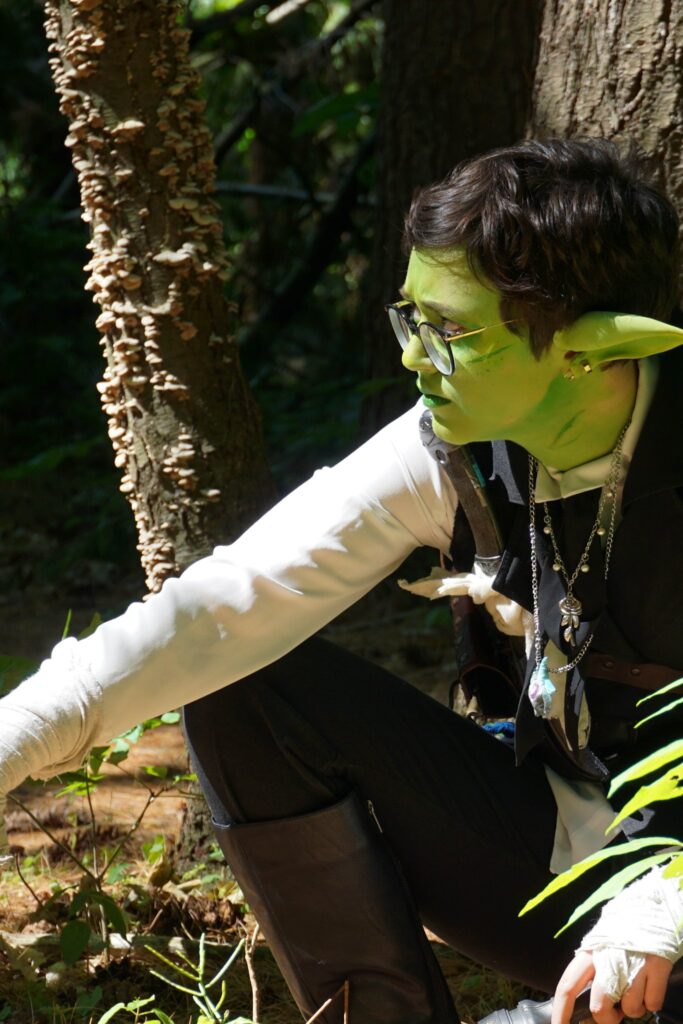
Goblins, identifiable by their green skin and pointed ears, are typically seen by other races as buffoonish. However, though it tends to manifest in unconventional ways, goblins are possessed of an interesting cunning and industrious nature. To those unfamiliar with their ways, their ideas can seem silly sometimes to the point of becoming dangerous. While this may be true on the surface, they are often no less effective. Goblins are often happy to play into this image letting people think them foolish and continue to underestimate them.
Goblins are a spiritually resilient race. Their spirits hold up to resurrections better than any other of the peoples in Ariel. They are also naturally agile, born with the ability to get out of the way of threats. These factors may have played a heavy role in the development of their penchant for risk taking. That said, they are not physically gifted people and when faced with the perils of combat, many lean on their natural talent for throwing weapons or sussing out an enemy’s weak spot from behind.
Perhaps the most curious element to goblin physiology is their complete lack of the ability to master the arts of magery. This deficiency is different to the difficulties other races have in learning to work arcane magics in that, regardless of the effort, their bodies are simply unable to conjure magical energy into a usable form. Spiritual energy and clerical workings are not affected by this trait. This unique facet has been the subject of much speculation and folklore. The stories range from them not coming from the same gods as the other races to it being the result of divine punishment, though no one is certain of the explanation.
Racial Bonuses
- Begin with 10 Skill Points (SP)
- Begin with 4 Life Points (LP)
- Begin with 3 Resurrections
- Begin with the Dodge skill
- May purchase LP to a maximum of 8 LP
- May purchase both the Thrown Weapon skill for half cost (rounded up)
- May purchase the Backstab skill for half cost (rounded up)
- Unable to purchase Magery skill
- Unable to purchase the Physical Prowess skill
Mandatory Costuming
- Green Skin (makeup or prosthetics should cover exposed skin)
- Pointed ears (elf-like)
Racial Aging
| Youth | Elderly | Aging | Max. Age |
|---|---|---|---|
| 14 years | 30 years | 5 years | 70 years |
Youth: This is the minimum starting age for a given race. This is also the minimum age that can be achieved through rejuvenating spells.
Elderly: This is the age when the effects of time begin to take their toll and benchmarks aging negatives for a character, eventually affecting their Life Points.
Aging: Upon reaching the age indicated in the “Elderly” column, a character’s maximum LP decreases 1 Life Point for every increment of years indicated in the “Aging” column. For example, if the racial maximum LP for a goblin is 8 LP, a 42-year-old goblin character would have a maximum Life Points of 6. (A 42-year-old Goblin is 12 years over “Elderly” and, marking two increments of aging at 5 years each, reducing that characters’ Life Points by 2.)
Maximum Age: Upon reaching the age indicated in “Max. Age” the character is deceased and may not resurrect.
Nations and Lands
Although goblins have few lands in which they are the primary residents by numbers, there are large goblin lands in most of the above-ground nations which have undeveloped territories. Goblins, perennial survivors and something of a force of nature all their own,
- Sorr Bukra is technically an Orc Reach, but overlaps with a land traditionally held by goblins that, at one time, had the name of Witherstoe. When the orcs of Sorr Bukra sought to expand their territory, hoping to claim some of the more successful farms and hunting lands of the goblins, the goblins cunningly renamed their land ‘Sorr Bukra’, thus leaving the invading orcs whose maps were poor with some confusion as to where the goblin territory they were meant to invade was, allowing the goblin armies to mass and keep settling orcs out. Scholars debate whether this technically joins the two lands, or if the two nations are simply immediate neighbours, with confusingly similar names.
- Garmungle is a goblin nation situated just east of Eldersire. One of the largest primarily goblin nations by numbers, the goblins local to the area keep and maintain extensive mechanisms that are spread across the lands they control, which are said to still be running from the days of the Golden Age. Notably, these machines that have caused the death of magic-capable elves who have tried to repeat the ritualized steps of the upkeep. Garmungle goblins tend to have at least a basic education in mechanisms, as tradition teaches that great harm might befall the area if the proper service is not performed to maintain the ancient works.
- Lost Chicken was not the intended name for the nation of goblins who have allied themselves with the Gnomes of Whistlewind, but stories dating back to the founding state that the goblins who settled the area had intended to continue travelling further west. One of the goblins was a farmer, whose prize rooster got out of the travelling coops, and as that goblin was a local leader, a substantial part of the convoy stopped to look for the missing rooster. By the time the rooster was found, snow was falling, and the goblins set up camp, eventually building the permanent structures that became the capital of Lost Chicken, a name that the other goblins teasingly made up for the settlement, which came to be known by that name by the neighbouring gnomes.
- Candipae is far to the north of Harodom, and perhaps it is the cold climates that have inspired the resilient goblins there in their studies of alchemy, herbal remedies, and medicine. Whatever the cause, the goblins of Candipae are said to be thoughtful and curious, and many of them gifted physicians, if eccentric in their ways. The Candipae goblins are appreciated by their neighbours, as mining and logging are perilous crafts, and the goblins are always happy to help stitch up a wound or re-attach an arm, never asking for help – but if the goblins seek aid afterward and are refused, it may be a generation or so before they return again. What goes around, comes around.
- Bordowl is one of the smallest ‘great’ nations of goblins, located near the Dwarves of Coralchipper. Skilled fishers and trappers, the goblins will often hire dwarven boats, taking them to small islands off of the coast, where the fishing is good, or to conduct trades with small communities that live there. Although the sailors of Coralchipper keep excellent maps, it is said that the goblins of Bordowl navigate by dead reckoning, using strange tools and reading the stars to know where they’re at – and where they need to go.
History
Since the telling of tall tales – both to outsiders, and to one another – is a great form of entertainment to a number of the goblin factions, goblin history is often considered to be embroidered. The most important part of tales of the old times, goblins will often agree, is not the specific name, the particular date, or the exact details of an event or battle, but the lessons that can be taken from it, and used in the future. (Besides, some of the goblin elders will add, it’s not as if most of the stories any other species tells have any proof beyond the writings of dead people.)
There is strong evidence that goblins in the Golden Age of Magic helped to advance the understanding of mechanisms and medicine. Although most advancements from that era end up credited to elven artifice, and artisans are not specifically identified by their species, authors of texts on anatomy, leverage, gear workings, and common ailments have names that fall more closely within goblin nomenclature than elven. While many goblins lived outside of the Golden Empire, some lived or worked within it, and it is quite clear that while they may not be able to work arcane magic, there are few other limits to goblin ingenuity, beyond imagination.
Following the Tear and the fall of the Golden Age, goblins appear more as supporting characters in a number of wars and squabbles than the centre of their own tale. Frequently mentioned in the same breath as orcs, goblins have been known to collaborate with the more physically mighty species, although in some cases, it seems that the goblins take on a support role – or in some cases, act as servants to giantkin such as ogres or trolls, on pain of death for disobedience. Goblins have fought on both sides of the various Wars of Understone (although rarely both sides during the same such war).
Frequently underestimated by magic-users and the more physically mighty alike, the development of the heavy windlass crossbow and the triggered timer trap mechanism are both attributed to goblin artificers, some of the most significant advancements during the last two hundred years in the fields of such devices. During the War of the Reeve in the Great Plains, the goblin heroes Winnock, Burrock, and Fain are credited with keeping the Scroll of Time out of the hands of cultists of Stasa, saving the nations of Whistlewind and Lost Chicken, through cunning and speed.
If goblins remain beneath the notice of the history books, it is likely at least in part out of an interest in avoiding too close a scrutiny.
Culture
Goblin culture is not a monolith, and a key aspect to the philosophy of many goblins is that there is no wrong way to be a goblin. Nevertheless, goblin folktales are full of stories of clever folk who outwit more physically intimidating opponents through guile and virtue, favouring those who withstand hardship, and lauding those who learn secrets only to use them at the most advantageous time.
Goblin music and art tend to be a melange; taking some of the virtues of lyrical composition from one culture, and fusing it with the driving beat of another, or melding delicate shading with large blocky composition. The uncouth might describe this as ‘artistic scavenging’, but to those goblins who consider the matter, the practice could also be considered taking the things that appeal most in art and music, and using them to create something entirely new. It’s no less creative, but a synthesis or fusion of old into new.
In smaller settlements, goblins will often defer to the strongest or most effective bully, whether or not that person is a goblin. Such people are useful, and besides which, dangerous – and, to a point, many goblins are willing to put up with a certain amount of being pushed around in exchange for some measure of security (often pointing out that, in a feudal system, humans, dwarves, elves, and gnomes do much the same). Such bullies should rarely rest on their laurels however; many is the folktale in goblin culture about tyrants being brought low that conveniently suggests where the first blade was inserted, or what blend of herbs led to severe, nay, fatal, gastric distress.
Goblins and Magic
Goblins are, of course, famously incapable of using arcane magic – with a heavy ‘but’ at the end. Goblins can and do use clerical magic, and many is the goblin diviner who has mystified even other seers, with strange auguries and insight into the hidden ways of the world. Too, there is nothing stopping goblins from using scrolls or potions, and many make use of these tools, either created by clerics, or purchased (or otherwise acquired) from those people who have fewer restrictions on their magical expression.
Perhaps as a result of their innate inability to use it, goblins don’t tend to put arcane magic on any kind of pedestal. The workings of the arcane are a tool that is denied them, and while goblins certainly recognize that it may be a useful tool when wielded with care and thought, it is no more lauded than would be heavy plate and chain – something that goblins are incapable of using, but which they have other solutions for. When a problem unquestionably requires an arcane solution, wizards who are considered ‘sensible’ (recognizing that while magic may quite literally make the world go ’round, a great deal of gold greases the engine) are employed.
In War
Goblin tacticians have a breathtaking ruthlessness that is seldom paralleled in most other sapient peoples of the Lakes Region. Often relying on small squad tactics, a common goblin strategy is to create an undeniable threat on one side of a foe, and use a smaller team to strike at a revealed backside. Ambush and terrain denial are also common for goblin skirmishers, who use traps and poisoned fodder to make captured territory not worth claiming for most invaders.
Alas, when joining other species in war, goblins are rarely so cleverly deployed. Orcs, ogres, and trolls will sometimes take advantage of goblins as shock troops, but rarely provide the avenue for withdrawal once the goblins have made their initial strikes, forcing the lightly armoured goblins to hold or die against forces that are no longer surprised. In the Age of Blood, where D’Shunn forces would often deploy coerced goblins, this was even more pronounced – in those cases, the goblins were given little to no support whatever, and were simply used as a bare speedbump to allow the less numerous D’shunn to get into position.
Shadow Goblins
Although unquestionably goblins, shadow goblins give pause even to the most reckless of goblin adventurers. Often voluntarily aligning themselves with infernal and undead forces, these goblins shun daylight, studying clandestine secrets, and it is whispered, seeking to bring about great ruin and destruction upon the world, for reasons that are unclear. Some are even said to have found ancient alchemical secrets that allow themselves to merge with insalubrious creatures, giving them venomous bites and toughening their skin to the point that it acts like plate.
These shadow goblins have – as a rule – declined to answer questions about their goals or intentions. Such is their creed that, if captured, most will seek to perish, escaping as spirits in order to resurrect elsewhere and continue their inscrutable aims.
Authored by: Andrew Dunlop
Fantasy Alive Lore Team 2026
Copyright © Endless Adventures Ontario