Buying and Selling Items
Look, there will be those who will tell you that power is expressed at the end of a sword, and others who will tell you that power is found in ancient tomes and magic rings. There’s one reliable source of power in the world that most of us live in, and it’s shiny and spends.
- Adeline of House Toth, Thoughts on the Continental Trade Agreement (1914 A.T.)
Ensuring that you have the right equipment to succeed in your adventures can be challenging. In terms of coin, adventure tends to cost money more than it makes money. What treasure can be recovered often takes the form of equipment, or less immediately fungible treasure, like jewels, rings, or elaborate vases and tapestries.
Craftspeople, for their own part, need to bring their wares to buyers. However elegantly crafted, most warriors have little need for more than a few swords or suits of armour at a time, and while it undoubtedly preferred by some tradespeople to serve their local community, they may find that the market reaches a saturation point with distressing swiftness.
Buying items to outfit yourself can be challenging too. If there is a local craftsperson that makes the goods you want,
Appraising
Most items have a generally agreed upon value – not one that is by any means guaranteed for purchasers or vendors, but one which reflects how the market values the item. Merchants, depending on their degree of experience, can acquire items for some percentage of this value, and can reliably sell items for a different, lower percentage – though they can charge what they like when dealing on an individual level.
Those with the Appraising skill may determine an item’s approximate value using the 12 middle characters on the item’s ID tag. These 12 characters are actually made up of 6 letter/number pairs.
Example:
E0F0A0C1Av4D3B0
Someone with the Appraising skill could then decipher this code thusly.
A B C D E F
0 0 1 3 0 0 – 1300 copper/130 silver/13 gold.
The Av represents the Availability of the item – its relative rarity in the general markets, and how easy it is for a merchant to buy or sell the item. This number corresponds to the availability in increasing measure: 1 = Common, 2 = Uncommon, 3 = Very Uncommon, 4 = Rare, 5 = Very Rare, and 6 = Unique. Unique items are difficult even for merchants to sell, and encompass goods made from rare materials, as well as many magical items. To sell such items, a merchant cannot simply use their skill – they need to make connections in the course of their adventures, and many hope to find valuable connections who can purchase such lofty items.
Bringing Items to Market
Large markets take longer to reach, but only there can someone looking to buy and sell items access sellers and buyers with whom to trade. Reaching a market takes 24 hours of Downtime, and then a subsequent 8 hours per Category of goods that you wish to transact with in trade. A successful merchant could then, presumably, seek out other pass-times – the amount of downtime available does not open up new markets.
Selling Without the Merchant Skill
Most people in the world aren’t trained merchants – the interplay with the market, the building of contacts, and the finger on the pulse of new mercantile opportunities is more than the average person has time to comprehend.
Without the Merchant skill, most people can buy and sell only a few common items, and those at bad rates. Non-merchants can sell two common items and one uncommon item per transaction, and will only receive 25% of the appraised value. They can buy two common items, but will pay 150% of the listed price for such items.
Selling With the Merchant Skill
People learning to be Merchants can buy and sell goods – but even they have to specialize. Merchants can learn the ins and outs of transacting specific Categories of goods, finding superior prices and larger markets for those categories that make up their specialties. In general, Merchants will find it easier to buy rarer items than to sell them, but true masters of the bargain can still sell a number of valuable and rare items in their time.
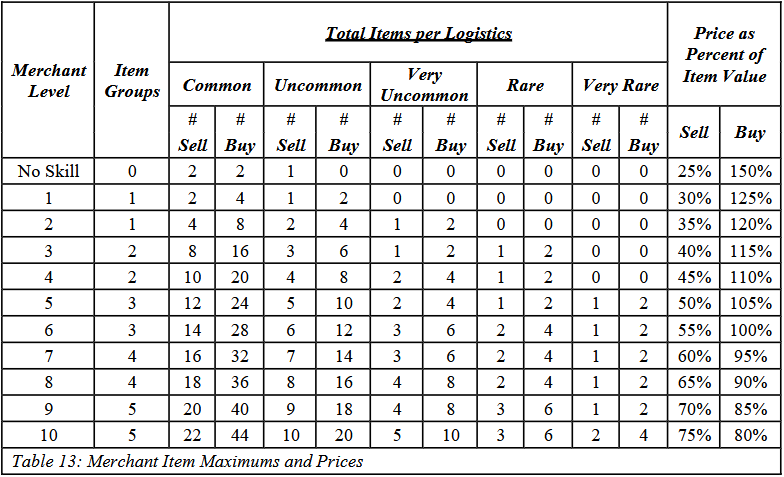
As this chart (found in the Manual, page 43) details, skilled merchants increase the number of categories or Item Groups that they can transact in, and how many items in those categories they can buy and sell.
The Item groups are broad categories of goods, all based around specific trade skills (or in the case of some base items, ‘General’).
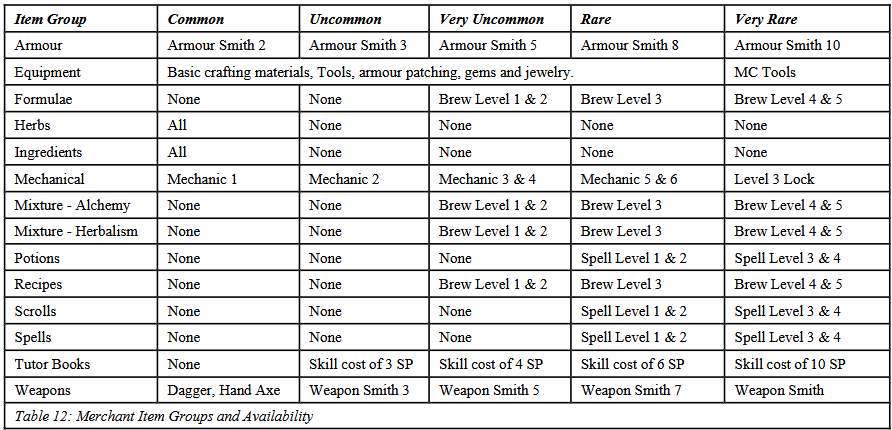
Even skilled merchants have limits – while Merchants may have access to broad markets, if they have not specialized in the Item Group of Very Uncommon, Rare, or Very Rare items that they are trying to sell, they can only secure 10% of the item’s value.
Items With No Appraisable Value
Some items have no value that can be determined using the Appraising skill. On one end of the spectrum, there are items that are more common even than common items – mundane pieces of clothing, clubs and staves made from branches torn off of trees, and sundry items that are usually purchased only very occasionally, but which could reasonably be expressed in terms of a copper or two.
On the other hand, there are truly one-of-a-kind items, more unique than even the Unique classification. An adamantine sword is Unique – but the holy hammer of Brack is singular. The demigod only has the one, and if one person in the world has it, no one else in the world does. Such items defy appraisal because there is no ‘market value’ for them; there just aren’t enough comparable items for a market to exist.
Items with no appraisable value can still be exchanged for coin, but exhaustively at the rate that the seller can convince others that it is worth.
Authored by: Andrew Dunlop
Fantasy Alive Lore Team 2026
Copyright © Endless Adventures Ontario