Orcs
“To bleed is to grow. It is through hard trial we find the weaknesses that must be cut out so that we might heal stronger.” – Chieftain Stora Truetongue
Overview
Recognizable by their green skin and large tusks, Orcs are renowned for a gift at manifesting a berserk rage that pushes their already substantial physiques to exceptional levels in combat. This has fed into the long held belief by outsiders that they are little more than hot tempered and violent savages. Orcs are just as varied as any other people however, and those who harbour such beliefs are sometimes surprised when their ignorance is exposed by orc sages or scholars, many of whom can recall centuries of their clan or nation’s oral history.
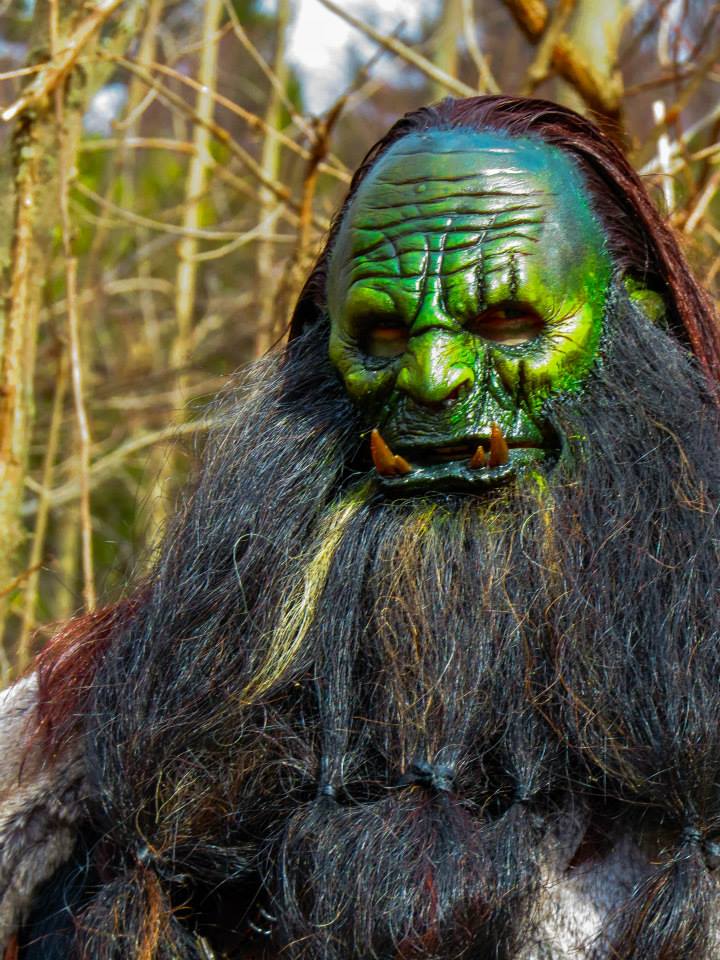
Orcs are one of the most physically robust peoples in Ariel. Even the average specimen can withstand grievous wounds and have been known to easily become resistant to toxins. They favour direct solutions and treat setbacks in their pursuits as opportunities to either prove their worth or learn from their failures. Orcs are skilled explorers and tacticians, able to see the ‘big picture’ in their journeys. Conversely, orcs struggle with the written word; reading, writing, and magery are frustrating, and this leads to some orcs deeming them as overly complicated and unnecessary.
Racial Bonuses
- Begin with 10 Skill Points (SP)
- Begin with 7 Life Points (LP)
- Begin with 2 Resurrections
- Begin with the Physical Prowess skill
- Begin with one Fury skill (any additional purchases require the pre-requisite skills)
- May purchase LP to a maximum of 15 LP
- May purchase the Resist Poison skill for 3 SP
- Must pay double for the Read & Write skill
- Must pay double for the Read Magic skill
Mandatory Costuming
- Green skin (makeup or prosthetics should cover any exposed skin)
- Tusks (fangs jutting up from the lower jaw)
Racial Aging
| Youth | Elderly | Aging | Max. Age |
|---|---|---|---|
| 15 years | 40 years | 2 years | 70 years |
Youth: This is the minimum starting age for a given race. This is also the minimum age that can be achieved through rejuvenating spells.
Elderly: This is the age when the effects of time begin to take their toll and benchmarks aging negatives for a character, eventually affecting their Life Points.
Aging: Upon reaching the age indicated in the “Elderly” column, a character’s maximum LP decreases 1 Life Point for every increment of years indicated in the “Aging” column. For example, if the racial maximum LP for an orc is 15 LP, a 44-year-old orc character would have a maximum Life Points of 13. (A 44-year-old orc is 4 years over “Elderly” and, marking two increments of aging at 2 years each, reducing that characters’ Life Points by 2.)
Maximum Age: Upon reaching the age indicated in “Max. Age” the character is deceased and may not resurrect.
Nations and Lands
Although there are lands under the control of orcs across Ariel, the Ranges are traditional orcish lands that hold great significance to orc sages. Some have permanent towns and villages built upon them, but others are left largely wild, with the orcs acting as stewards of the land, learning and discovering the mysteries of their large territories.
Below are the seven Great Ranges – large territories that the orcs largely have uncontested control over within Ariel.
- Ang Gijak – One of the two orc ranges closest to Harodom, Ang Gijak has a number of orc principalities that share rulership over the range as a whole. Representatives of these principalities are selected by acclaim, and for the past century or so, the orcs of Ang Gijak have been – mostly – friendly to the people of Harodom, Eldersire, Michian, and Detter. Ang Gijak has a representative band of Dust Banner orcs who practice necromancy – but while not strictly shunned, Dust Banner representatives are treated with extreme caution, given whatever they ask for, and then hopefully sent along their way.
- Sorr Bukra – The other of the two orc ranges within the Lakes Region, Sorr Bukra borders the City State of Portnos, and is opposite the Duchy of Dwadain across Jagari Bay. With several built up settlements, the largest of these is Sorr Bukra itself, from which the range derives its namesake. Sorr Bukra has been in a state of war with Hammerfrost, Eldersire, Harodom, and Detter for about forty years, although this mainly takes the form of the difficult-to-farm Range’s warriors raiding border farms for foodstuffs and supplies.
- Vell Bardik – Far to the West of Ariel, bordering on the Sea of Ice, the Orc range of Vell Bardik is a near neighbour to the minotaurs of the Yat’turth territory. Uneasy neighbours, the orcs hunt and fish on the Sea of Ice, and serve as the basis for a number of folktales and legends. The Warriors of Vell Bardik are said to arrive only when the snow flies, and to leave no survivors in war – leading to a fearsome reputation. Traders and merchants from Vell Bardik deny this, but this merely raises the question – if they are not behind these attacks, then who is?
- Fann Korra – The keepers of Fann Korra are said to bear within them the spirits of great birds that once roamed the plains in the middle of Ariel. Whether this is true or not, the orcs of Fann Korra move swiftly, crossing the vast distances between settled parts of their Reach in short order, owing in part to their adoption of riding lizards. On the opposite side of the Necropolis of An’xar from Whistlewind, Fann Korra’s secular leaders maintain a tremulous truce between those orcs who would see the undead that issue forth from the necropolis put down in battle – and those that would try to wrest control of the undead.
- Enging Roz – Now much diminished by a great sickness that overcame the Range in the 1980’s, Enging Roz was once known for its scholars and physicians, so great was its bounty that it could support schools for those who would make these softer lines their life’s work. On the West Coast of Ariel, the scholars and physicians of Enging Roz are still extant, but the College of Enging is but a fraction of its once proud size, and worshippers of Kazzok on the Range have made several credible bids for dominance, swelling the nation’s forces with demons.
- Kan Vizek – Kan Vizek is famous for its sailors, although others might say for its pirates. On the East Coast of Ariel is the Range of Kan Vizek, which claims territory up to thirty miles from the coastline. The capable privateers of the range charge ‘tolls’ to any passing ships, and are more than capable of handling aggression from those who have difficulty with the question of ‘Your money or your life?’. The orcs of Kan Vizek are capable fisherfolk as well, and tend to be among the most prosperous of the Ranges – owing in no small part to the Banner of Tears privateers that sail their seas.
- Ra’zir Wehr – Little is known of Ra’zir Wehr; even orcs of other Ranges know little of the internal workings of the Range. Those that enter with the invitation of the residents have little to say about their experiences within, and those that enter without that invitation either do not make it far in before they are met and escorted out by capable warriors, or never emerge. Shrouded in secrecy, the orcs or Ra’zir Wehr seem to prefer it – and have little friendly to say to those that would uncover those secrets.
Orc Banners
Named for banners of war – large flags that indicated allegiance and helped groups of like allegiances to find one another and identify their foes – the banners of the orcs serve a similar function, but do so across Ranges. Banners instead represent dominant ideologies, which are represented in the different Ranges to greater or lesser extents. While many orcs have no banner to which they subscribe, those that seek leadership roles in the Ranges will often have to court the favour of one or more banners – for with their support, the bid for leadership is more likely to succeed. While smaller Banners exist, these below are the most represented at this point in time.
The Banner of Steel is one of the largest banner-groups in modern day Ariel. It represents those orcs who believe that through martial pursuits, the orcs can best ensure their survival, and negotiate with other lands from a position of strength – if they don’t simply seize what they want.
The Banner of Fire represents most of the faiths, and holds that it is through fierce and determined faith that orcs can best build a future. Banner of Fire orcs who hold clerical investment tend to be zealous in their belief, and while it is not unheard of for Banner of Fire orcs to come from opposing faiths, it’s also not unheard of for them to come to blows over matters of belief.
The Banner of the Hammer believe that through the aggressive pursuit of industry, orcs can make a place for themselves in the modern world. Reaches that have strong Banner of the Hammer representation tend to be places in which new buildings are constructed, leather and metal goods are made, and the fires in a settlement are as likely to be forges as cooking fires.
The Banner of Tears is well-represented in Reaches and orcish settlements that do considerable work on the water, whether that be seafaring, hunting on polar ice, or running a river ferry. Although technically represented under the Banner of Fire, Balaxan and Beldonite orcs will sometimes claim the Banner of Tears instead, due to ideological differences.
The Banner of Blood perhaps unintuitively represents the healers and farmers of the orcs. Believing that blood is one of the vital essences that sustains life (and that, metaphorically, food and drink become blood), Banner of Blood orcs pursue those things that they believe healthful in life.
The Banner of Shadow holds that secrecy is as much a weapon as a battleaxe. Scouts, spies, and assassins, Banner of Smoke orcs take no exception to the idea of a vast and bloody battlefield – occupied by others. Their place is the shadow, and in holding the secrets that keep unwinnable fights at bay.
The Banner of Smoke is the smallest of the orcish Banners, and holds orcish scholars and sages, most of the orc mages and wizards, and soothsayers and diviners. Their ideology is rarely dominant, but they are sometimes sought for counsel when unusual instances occur.
The Banner of Dust are necromancers. The closest thing to an ideology that they get a chance to voice is that it’s waste to consign bodies to the ground or charnel pit, when such useful tools could be otherwise applied. Not every Reach tolerates them – but every Reach has some.
History
It is said that before the Tear, when many orcs lived in (relative) harmony with the rest of the Golden Empire, they were made stewards of vast lands of otherwise unoccupied wilderness, to keep the peace, hunt fugitives from justice, and maintain a balance between the forces of civilization and the forces of nature. Many of the orc Reaches today can point to monuments or ruins dating back from this age as signs that their heritage on such lands is an ancient one.
In the years following the Tear, orc warriors leveraged their great strength and ability to whip themselves up into a fury to great advantage, creating a well-earned reputation for domination upon the battlefield. Sometimes conquerors, sometimes mercenaries, and sometimes defending their own Reaches against aggressors, orc forces have participated in at least ten of the fifteen Wars of Understone. In the mid 19th century, orc forces from Vell Bardik and Fann Korra joined forces with large contingents of trolls and ogres as well as a smaller number of true giants, sweeping across the plains before eventually meeting a unified force of the Dwarves of Understone at the edge of Jagari Bay.
While some orc warriors of Sorr Bukra joined up with the forces of Estovic during the Estovic Wars (2009-2011 A.T.), there has not been significant war between any of the major Reaches and nations of the Lakes Region in the past fifty years. Regional raiding notwithstanding, many of the Reaches have opened up trade relationships with nearby nations under the Continental Trade Agreement, although as with any nations, such agreements are fragile and subject to change when conditions become extreme.
Culture
Much of Orcish culture falls between the poles of brutal pragmatism and passionate expression. Orc music is almost always accompanied by a vocalist, and while it is not required that the lyrics of such music tell of a lesson from history, much of it does. Orc poets and storytellers similarly help to keep orc history alive through the retelling of stories and traditions that have remained word-perfect and unchanged for centuries.
Visual art and sculpture among orcs tends to use vibrant colours and bold shapes – while not necessarily representing how something literally appears, it shows how the artist perceived it. Orc art often follows themes of nature or of conflict, mostly because those themes tend to meet popular approval. Orcish food is often heavily spiced, and uses salt and smoke in preservation of perishables.
In most of the Reaches, leadership arises through acclaim, and leaders remain in place until their role is contested. While that contest is – theoretically – a fight to the death, the pragmatic Reaches have realized that having their most powerful warriors struggling to the death for dominance means that following a contest, many of their best combatants are disabled or even dead. As a compromise, and because there is more than one way to be strong, many Reaches will instead have leadership determined by acclaim – if a leader can sway enough orcs to voice support for them, then they’re probably a good leader. Since those leaders are not necessarily skilled warriors, in a time of war, such a leader might pick a War Leader to handle tactics and military action.
The Lost Reach
It is said that one of the Great Reaches was cursed by the gods – although tales differ as to where it was originally, and which gods were so offended. Some claim that it was swallowed up in storms and earthquakes, and that ancestral treasures of the orcs still lie beneath. This lost Reach, called Venn Gargath, is thought by even many orcs to be a metaphor; telling of the necessity of piety, and care in dealings with powerful entities.
Authored by: Andrew Dunlop
Fantasy Alive Lore Team 2026
Copyright © Endless Adventures Ontario